

 Admin
AdminTaking your TfL topographical assessment can feel like a high-pressure moment. For many aspiring private hire drivers in London, this test is the most significant hurdle between them and their career. The nerves are natural; after all, your ability to navigate the city's complex streets is at the heart of your new profession.
At PCO GO, we have helped thousands of candidates navigate this process. We know exactly what happens inside that exam room, and, more importantly, we know why some people pass with flying colours while others struggle. In this guide, we’re going to walk you through exactly what to expect on the day and how to prepare so you can walk into that test centre with total confidence.
1. Understanding the Test Format
Before you can conquer the test, you need to know what you are up against. The topographical assessment is a 90-minute, computer-based exam. It is designed to test your ability to use maps, plan routes, and understand London’s geography.
The Breakdown of Questions
The test usually consists of around 25 to 29 questions. While the exact number can vary, the structure remains consistent:
- Multiple-Choice Questions (MCQs): These usually make up about 25% of your total marks. They cover map symbols, grid references, and compass directions.
- Route Planning Questions: These are the "heavy hitters". There are typically 4 of these, but they account for roughly 75% of your marks.
Because route planning is so critical, your success depends on your ability to draw the most direct, legal route between a start point (green marker) and an end point (red marker). If you haven't practised this on a computer, we highly recommend booking a session at our topographical map training centre to get used to the software.

2. Preparation: The Night Before
The key to a stress-free test day starts 24 hours before you even arrive at the centre. Panic usually sets in when things feel rushed or forgotten.
Your Essential Checklist
Make sure you have the following items ready the night before:
- Primary Identification: You must bring your valid UK driving licence or your passport. Without these, you will not be allowed to sit the exam.
- TfL Application Details: Keep your application reference number handy.
- Route Planning: Check the location of your test centre and plan your journey to arrive at least 20 minutes early. London traffic is unpredictable, and arriving late can result in a forfeited booking.
Insider Tip: Avoid heavy "cramming" the night before. If you have already completed our PCO license application support and attended our training sessions, your focus should be on resting your mind so you can stay sharp during the 90-minute window.

3. Inside the Exam Room: What Happens?
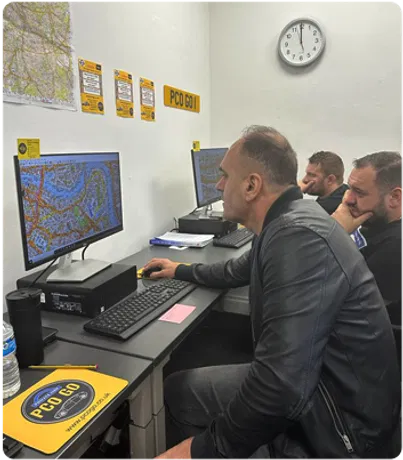
When you enter the room, you will be assigned a workstation. The environment is professional and quiet. A staff member will verify your ID and give you a brief overview of the computer interface.
Mastery of the Mouse
One thing that surprises many candidates is that you only use a mouse. You will not be using a keyboard. You must be comfortable with:
- Clicking and dragging to move the map around.
- Using the scroll wheel to zoom in for fine details (like one-way arrows) and zoom out to see the bigger picture.
- Drawing lines accurately between markers.
At PCO GO, our computer-based training specifically replicates this environment so that the first time you use the software isn't on your actual test day.
4. Strategic Time Management
Ninety minutes might sound like a long time, but it can disappear quickly if you get stuck on a difficult question. We recommend a "big marks first" strategy.
- Start with Route Planning: Since these 4 questions carry 75% of the marks, spend the first 40–50 minutes getting them perfect.
- Move to MCQs: Once your routes are drawn, tackle the multiple-choice questions. These are usually quicker to answer.
- The "Skip and Return" Rule: If a question is particularly confusing, don’t let it eat up 10 minutes of your time. Skip it, move on, and come back to it at the end if you have time left.
- Final Review: Always aim to leave 5 minutes at the end to double-check that your routes start and end exactly on the markers.

5. Common Pitfalls and How to Avoid Them
Even candidates who know London well can fail if they don't follow the specific rules of the TfL assessment. Here are the most common mistakes we see:
The "Most Direct Route" Trap
TfL isn't looking for the fastest route or the route you’d take in real life to avoid traffic. They want the most direct legal route. This means sticking as close to a straight line as possible while following the roads. Taking a wide detour because you think it's "easier" can cost you points.
Missing Map Symbols
This is the most frequent cause of failure. If you drive the wrong way down a one-way street or enter a restricted road (often marked in blue, grey, or pink), you could get zero marks for that entire question. Always zoom in to every junction to check for the following:
- One-way arrows.
- No-entry signs.
- Roundabout directions.
Marker Precision
Your route must start exactly on the green marker and finish exactly on the red marker. If your line stops even a few millimetres short, the system may register it as an incomplete route.
6. Next Steps After the Test
Once you finish the test, the waiting game begins. You typically won't receive your results instantly; TfL usually communicates them within a few weeks via email or post.
While you wait, don't stop your momentum. Most drivers still need to complete their SERU test prep or finalise their PCO medical and DBS checks. At PCO GO, we offer a full suite of licensing services to ensure that once your topographical result is in, you are ready to hit the road immediately.
Conclusion
The topographical test is a challenge of precision and patience, not just geographical knowledge. By preparing the night before, managing your time inside the room, and focusing on the high-value route planning questions, you significantly increase your chances of a first-time pass.
If you’re feeling nervous or want to practise on the actual software used in the exams, contact our team today. We’ll help you master the maps and get you one step closer to your London PCO licence.
Frequently Asked Questions
How long is the topographical test?
The test lasts for 90 minutes and is conducted under exam conditions at a TfL-approved centre.
What is the pass mark for the topographical test?
The pass mark is usually 60%, but because the route-planning questions carry so much weight, you must get those right to ensure a pass.
Can I use a satnav during the test?
No. You are only allowed to use the computer-based maps provided within the exam software. This is why learning to read digital A-Z-style maps is essential.
What happens if I fail?
If you don't pass on your first attempt, you will need to rebook. To avoid the extra cost and delay, we strongly suggest attending a training session before your first try.
Do I need to take the SERU test too?
Yes, the SERU (Safety, Equality, and Regulatory Understanding) assessment is a separate requirement for all PCO drivers.